The Fushimi Inari Shinto shrine or Fushimi Inari Taisha (伏見稲荷大社)the shrine, south of the city of Kyoto, is one of the best known and most important shrines in Japan. It is also one of the oldest, dating back to the 8th century. Definitely a special visit if you are in the Kansai region.
In addition, Fushimi Inari Shrine in Kyoto is the main shrine dedicated to the Inari deity. But it is not the only one, as there are around 32,000 shrines in Japan dedicated to the deity.
Fushimi Inari, located in the municipality of Fushimi, is easily accessible from both Kyoto and Nara. It's also open 24 hours a day, making it perfect for compact or hard-to-schedule itineraries. And, of course, it's one of the places we recommend you visit in our post on what to see in Kyoto.
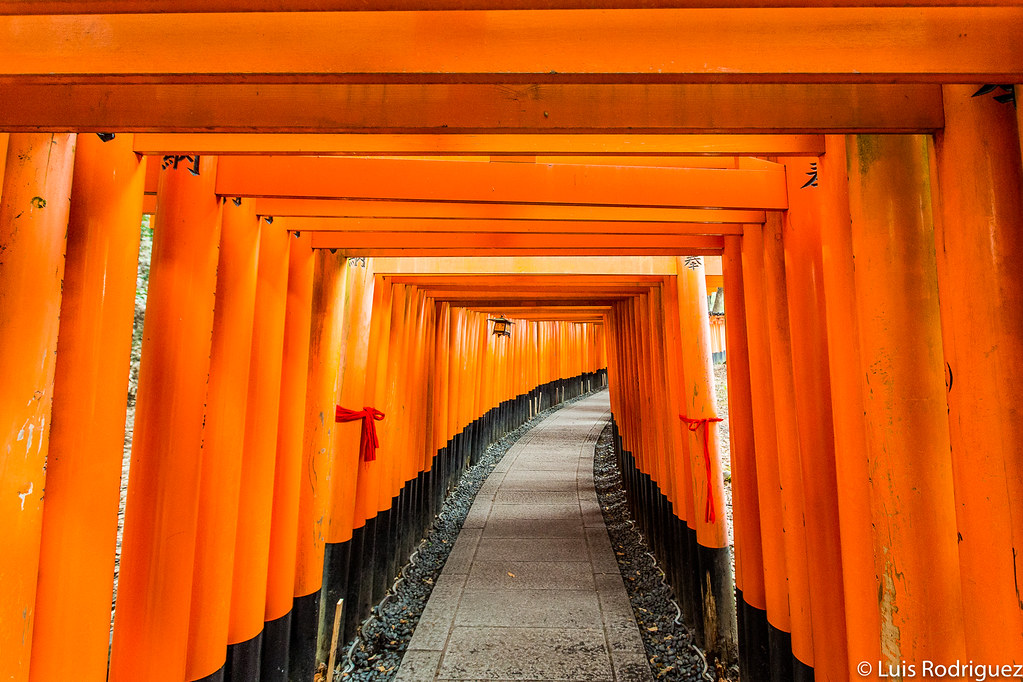
Fushimi Inari Shrine Tour
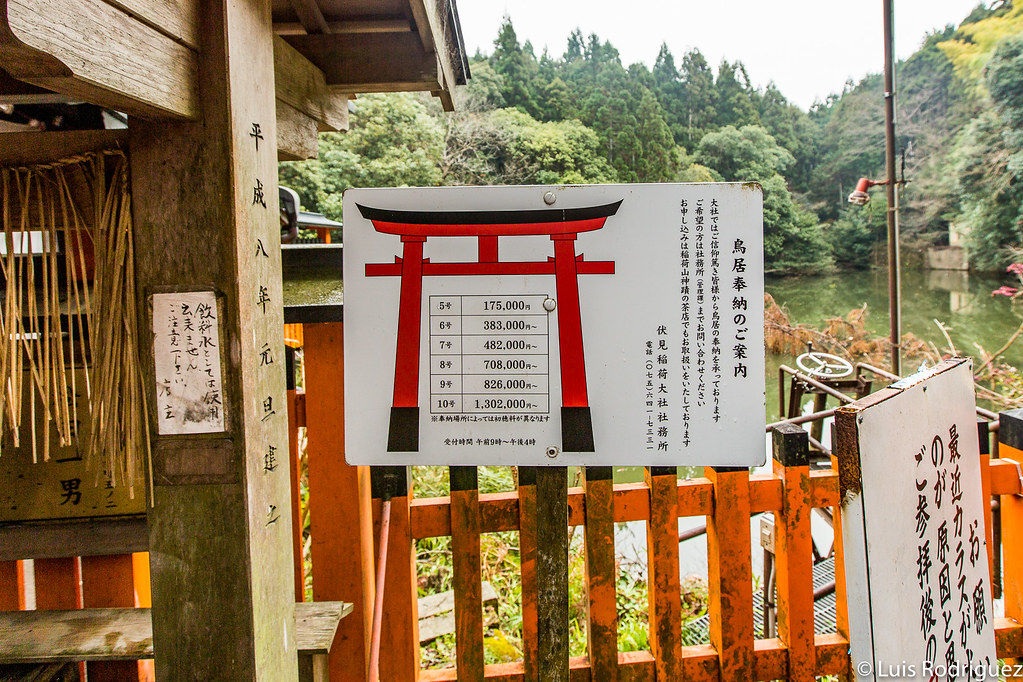
Inari is the god of rice and therefore the patron saint of merchants, since in ancient times a good rice harvest was associated with prosperity in business. This explains one of the most striking features of the sanctuary: the thousands of torii the 4 kilometres of paths, which almost seem to form a roofed passageway, have been donated by traders who put their names or the names of their businesses on the torii so that the god Inari may be propitious to them.
Walk the 4 kilometres of paths with torii is a beautiful experience that we highly recommend. However, it can be a tiring walk because the shrine is located at the foot of Mount Inari. The paths are always going uphill and by the time it's time to go down, you tend to be quite tired. And if you visit in the summer, when it's extremely hot, it can be tough. Don't forget to take isotonic drinks, water and a snack... but it's definitely worth it!
We propose a three/four hour walking route, which allows you to visit the sanctuary, walk through the thousand gates, and visit the sanctuary. torii and enjoy nature at the top of Mount Inari. But of course there are many different trails, which you will find en route, marked on the maps you will see on the mountain.
That's why we recommend you to have a look at the map and adapt the view to the time and desire you have. As always, remember that you can integrate the map into your Google Maps and use it during your trip. We tell you how to do it in Maps for travelling to Japan.
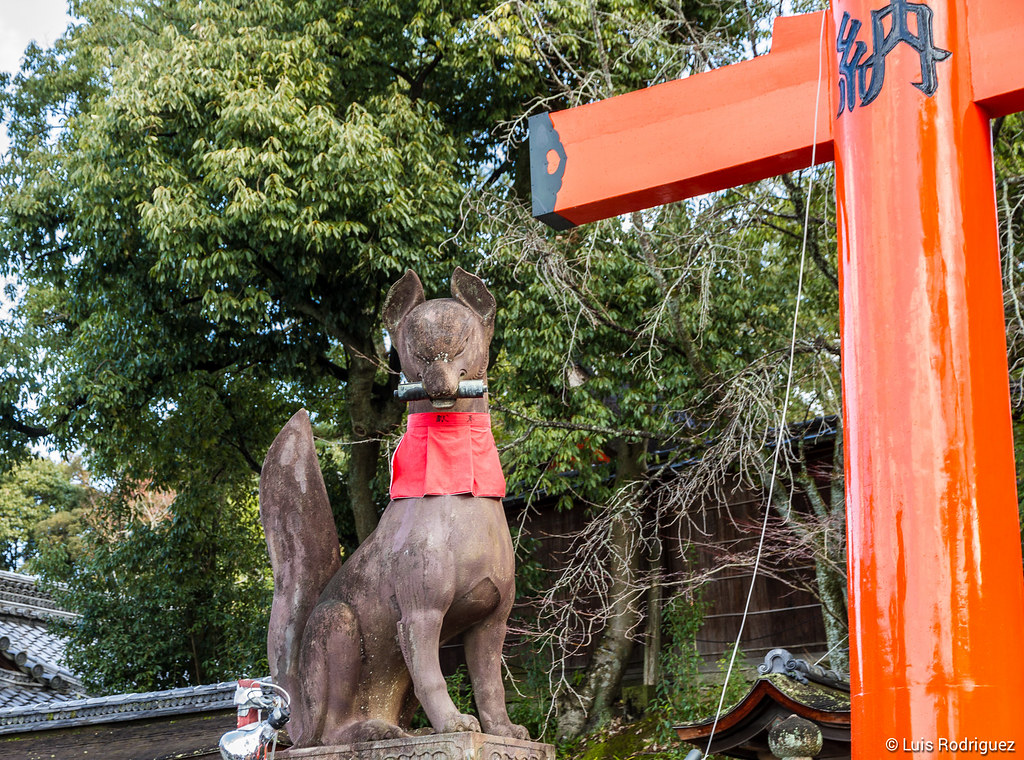
Below, we'll tell you a little about the main tourist attractions at Fushimi Inari Shrine. But first, a note: As is customary at all shrines dedicated to Inari, the fox, or kitsune is one of the prominent figures because he is the messenger of the god Inari.
So as soon as you leave the train station on your way to the shrine you will see the first kitsune but you will also find several more at various points along the rice field. They often have a key in their mouth, which represents the place where the rice, and therefore wealth, is kept.
The route starts at JR Inari station. From there you will have to walk 200 metres after passing the first large torii The vermilion-coloured route will take you to the Romon gate. From there follow the proposed route, which you can change and adapt as much as you like.
Romon Gate
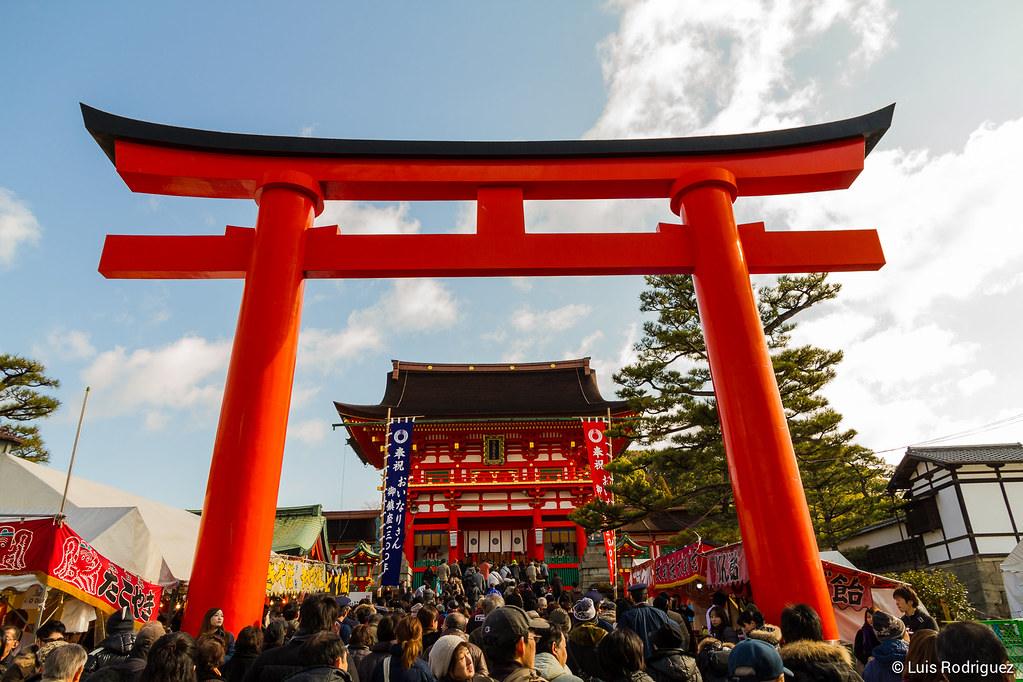
The Romon Gate is the main entrance gate to Fushimi Inari Shrine, which you will see just after passing the second large torii red
The gate was built by order of the regent Toyotomi Hideyoshi in 1589. Legend has it that when Hideyoshi's mother fell ill, he prayed to the deity of Inari and promised a generous donation if his mother's health improved. His prayers worked, and with Hideyoshi's donation, the Romon Gate was built as the main entrance gate to Fushimi Inari Shrine.
Honden Main Hall
After passing through the entrance gate, you arrive at the Honden Main Hall, it has been declared an Asset of Cultural Interest. The five deities of Mount Inari are enshrined in this hall.
The building, in the style of uchikoshi nagashi-zukuri and quite large for its type, it has corridor decorations typical of the Azuchi-Momoyama period (late 16th century) and 10.6-metre-high walls. The decorations are colourful and dynamic, such as gold pendants. konpukurin on the ceiling, metal decorations tarukibana or the roof rails kaerumata.
All the buildings were burnt down in the Onin Rebellion in 1468, but thanks to generous donations from the citizens, the sanctuary was rebuilt in 1499.
The Thousand Gates or Senbon Torii
After seeing the buildings near the main hall you will arrive at the thousand gates torii vermilion-coloured or Senbon Toriiiconic image of Fushimi Inari Shrine.
The Gates torii vermilion-coloured are painted using the technique of inari-nuriThe shrine, like the main shrine, is a place of great spirituality. Since the Edo period (1603-1868), the faithful have been donating the gates of the shrine. torii to request and thank the favours of the deity of the sanctuary, thus creating this famous path of a thousand doors. torii covering the entire route from the inner sanctuary to the summit of Mount Inari.
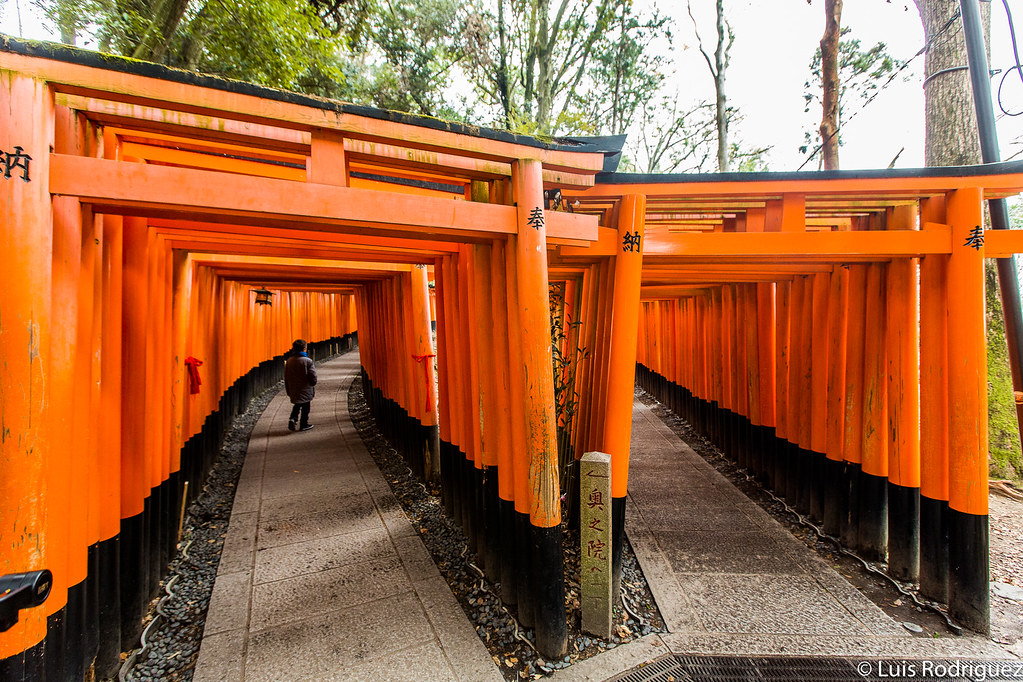
Okusha Hohaisho, the prayer hall
At the end of the road of a thousand gates torii or Senbon Torii you will reach the Okusha Hohaisho, as known as Okuno-in, the prayer hall of the inner shrine. Built in 1499, this is where the deities of Inari Mountain are prayed to. In fact, the shrine is aligned so that the three peaks of the mountain can be seen from here.
Okuno-in was built in 1499, but was completely destroyed by a natural disaster in 1794. It was rebuilt to a slightly larger size and finally moved to its present location in 1975.
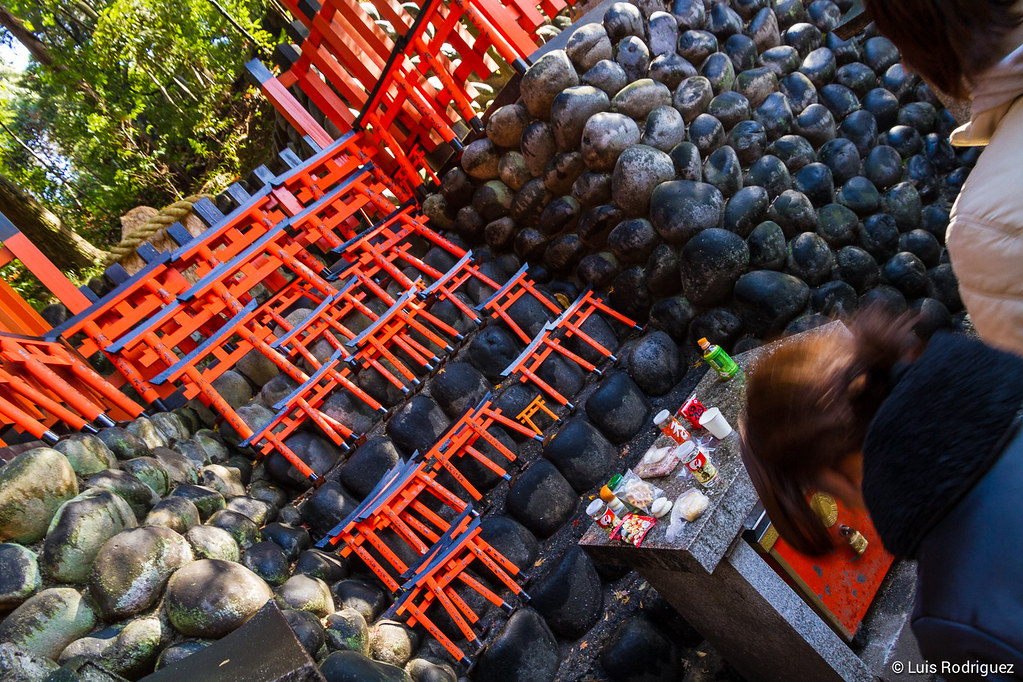
Omokaru-ishi stone lamps
A la derecha del Okuno-in hay dos lámparas de piedra llamadas Omokaru-ishi. It is believed that if you make a wish in front of one of the lamps and then lift the top and it seems lighter than you expected, your wish will come true. If, on the other hand, you lift the top of the lamp and it seems heavier than you expected, your wish will not come true.
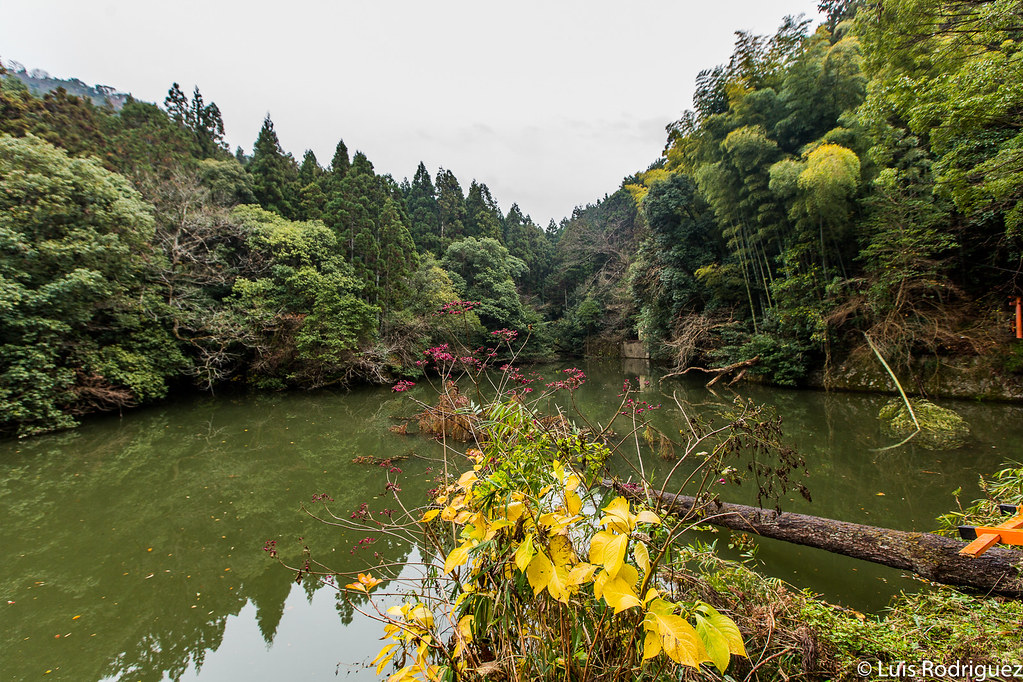
Estanque Shin-ike o Kodamagaike
If you follow the road, you will pass through the Shin-ike Pond, sometimes also called Kodamagaike. Legend has it that if you are looking for someone, by clapping your hands twice at the foot of the pond, the echo will show you the way to find the person you are looking for.
Yotsu-tsuji Intersection
About 20 minutes later, you will arrive at the Yotsu-tsuji Intersection. The view of the Fushimi Inari Shrine is beautiful. In summer, temperatures here are a little cooler (but not too cool), while in autumn you can enjoy the momiji which contrasts with the vermilion of the torii.
From here you can go to the Kojin-mine Viewpoint, the Tanakasha Shrine, located behind Tanakasha Shrine, is one of the best places to enjoy the view of Kyoto and Mount Inari. If you walk a little further, you will come to the Miyuki Hohaisho Sanctuary.
Opened in 1963, this prayer hall is popular for its fude-zuka, the place where old calligraphy brushes are ritually buried. It is surrounded by black bamboo trees, creating a spectacular atmosphere.
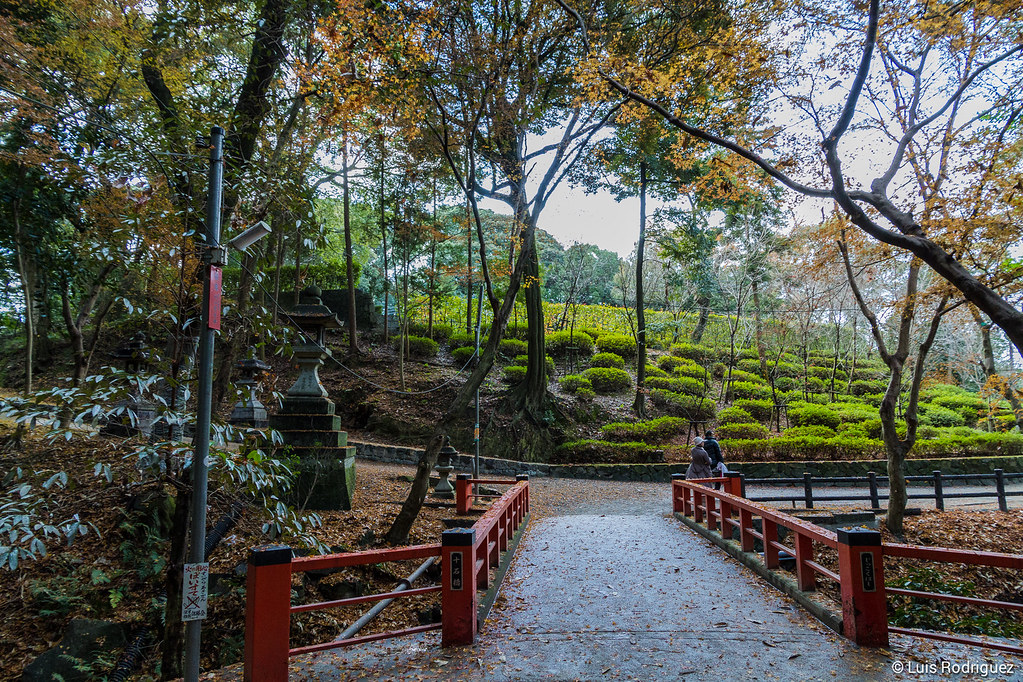
Third San-no-mine summit
If you follow the proposed itinerary, you will then reach the third peak of Mt. San-no-mine. Here you will find the ancient ruins of the Shimosha Shinseki shrine, where the deity Shiragiku Okami is worshipped.
Ai-no-mine intermediate summit
A gate torii stone, called Nunetorii, indicates the access to the sacred area of Ai-no-mineThe Ise no Okami deity is worshipped at an intermediate peak.
The Gate torii Nunetorii deserves special attention because of its beautiful decorations similar to those of the style gasshotypical of Shirakawago village houses, for example.
Second Ni-no-mine summit
You will then reach the second summit Ni-no-mine. Here is the ancient Nakasha Shinseki shrine where the deity Aoki Okami is worshipped.
Ichi-no-mine summit
About 10 minutes later, you will reach the main summit of Mount Inari, or Ichi-no-mine, located 233 metres above sea level. There you have the ancient Kamisha Shinseki shrine where the deity Suehiro Okami is worshipped.
Here it is popular to draw fortune papers omikuji which, according to the people in Kyoto, are usually quite accurate.
Santuario Mitsurugisha
About 15 minutes later, you will be in the Mitsurugisha Sanctuary, where the deity of Kyoto's Shimogamo Shrine is enshrined. Next to the shrine you can see the Kaminari rock or Kaminari-iwa, or ‘rock of thunder’, as legend has it that it was struck by lightning and thunder in the past.
Yakurikisha Sanctuary
Nearby, just 5 minutes away from the summit of Mount Inari, you have Yakuriki Sanctuary or Yakurikisha which, as its name suggests, is famous for its healing powers.
Here the deity of coughing is enshrined, which is why many theatre actors kabuki they come here to pray that their voice will not fail them.
Gozendani Hohaisho
Just 200 metres further on is the Gozendani prayer area. Situated between the three peaks of Mount Inari, it is the ideal place to pray to the deities of Mount Inari, as from here you have a privileged view of the whole mountain.
There are many festivals held at Gozendani, but the most popular is the Oyama-sai festival, which is held here every 5th January at 1.30pm. At this matsuri or festival hangs a sacred rope shimenawa and sake is offered to the mountain deities before making a sacred pilgrimage up the mountain.
From the Gozendani you reach the Kiyotaki waterfalls. Located 200 metres downhill, if you follow this path you will be far from Fushimi Inari Shrine but you can still reach the waterfalls. templo Tofukuji y al templo Sennyuji en un camino totalmente diferente y espectacular. Lo tienes marcado en el mapa, por si te interesa o ya has estado en el santuario y quieres ver otras cosas.
Santuario Suehiro
Unos 45 minutos después de dejar atrás la zona de plegarias de Gozendani y cruzar de nuevo las intersecciones Yotsu-tsuji y Mitsu-tsuji llegarás al santuario Suehiro, popular por sus ranas guardianas o kaeru-koma.
Normalmente los guardianes de los santuarios son una especie de león-perro mitológico o zorros, muy típicos estos últimos de Fushimi Inari. Sin embargo, en el santuario Suehiro verás ranitas, por lo que este lugar es de especial interés.
El santuario es muy popular, tanto por las propias ranas, como por la inscripción que hay en ellas, un auténtico juego de palabras: fuku kaeru (福かえる) que puede ser «ranas de la suerte» o «el retorno de la suerte».
Hatsumode en el santuario Fushimi Inari
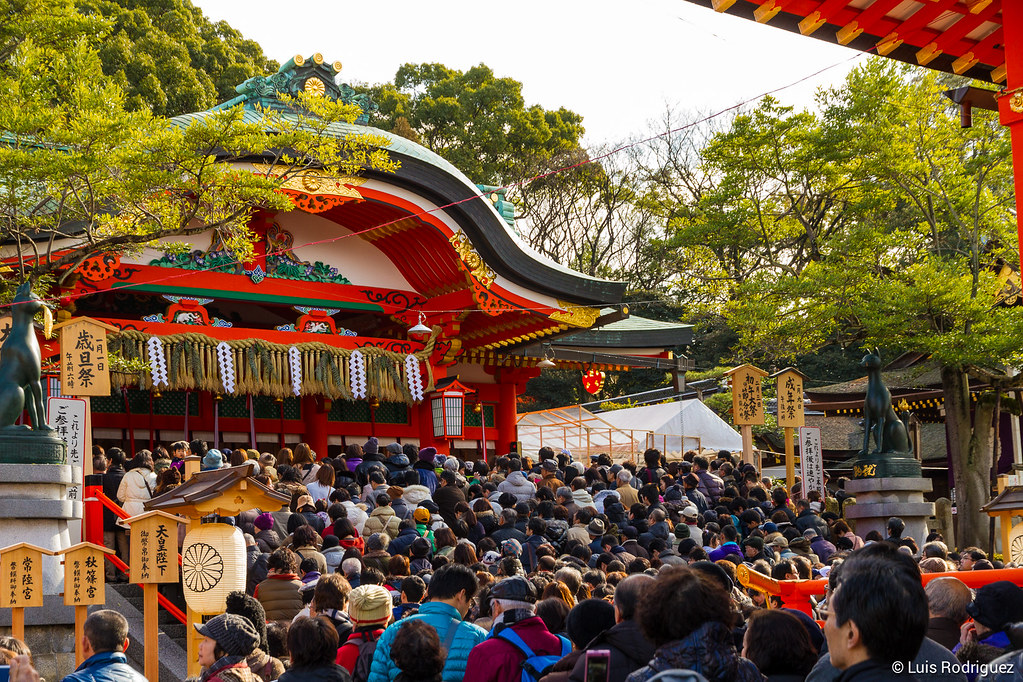
Uno de los momentos más especiales para visitar Fushimi Inari es durante el Hatsumode, que si recuerdas de cuando hablamos sobre el mes de enero en Japón, es la primera visita del año al santuario. Esta primera visita tiene lugar durante los primeros días de enero, cuando los japoneses todavía están de vacaciones de Año Nuevo.
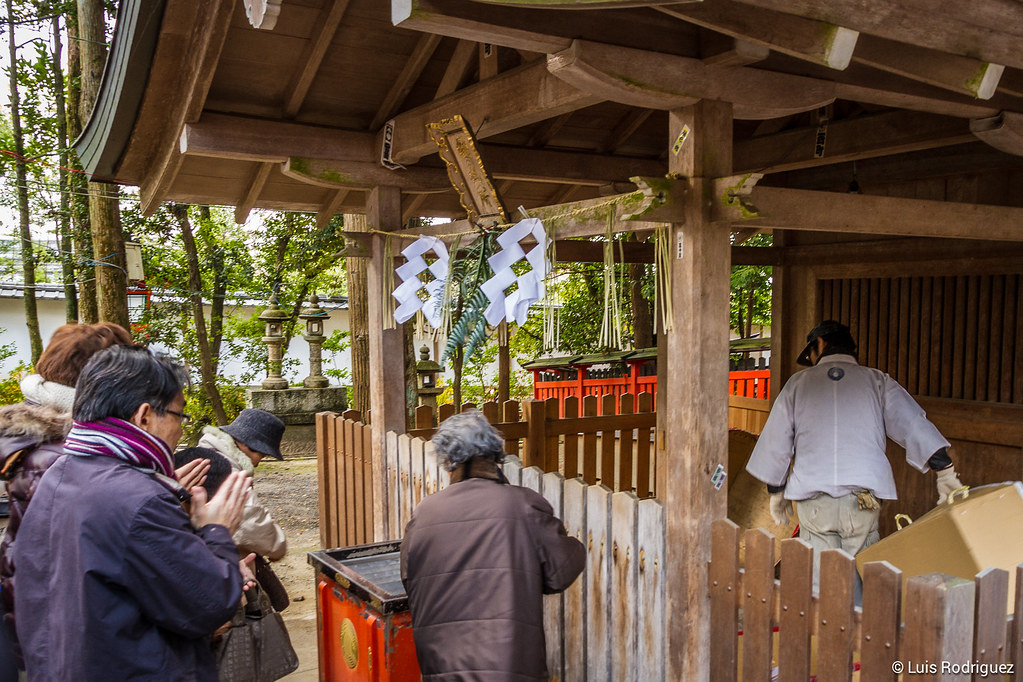
Si ves las fotos, puedes comprobar lo que te decimos, porque la cantidad de gente que había esperando para hacer la ofrenda en el santuario principal y pedir al dios que les escuchara era tremenda y muy emocionante.
Según datos del The Japan Times, en 2010 visitaron el santuario 2,7 millones de personas durante únicamente los tres días de fiestas de Año Nuevo… ¡una locura!
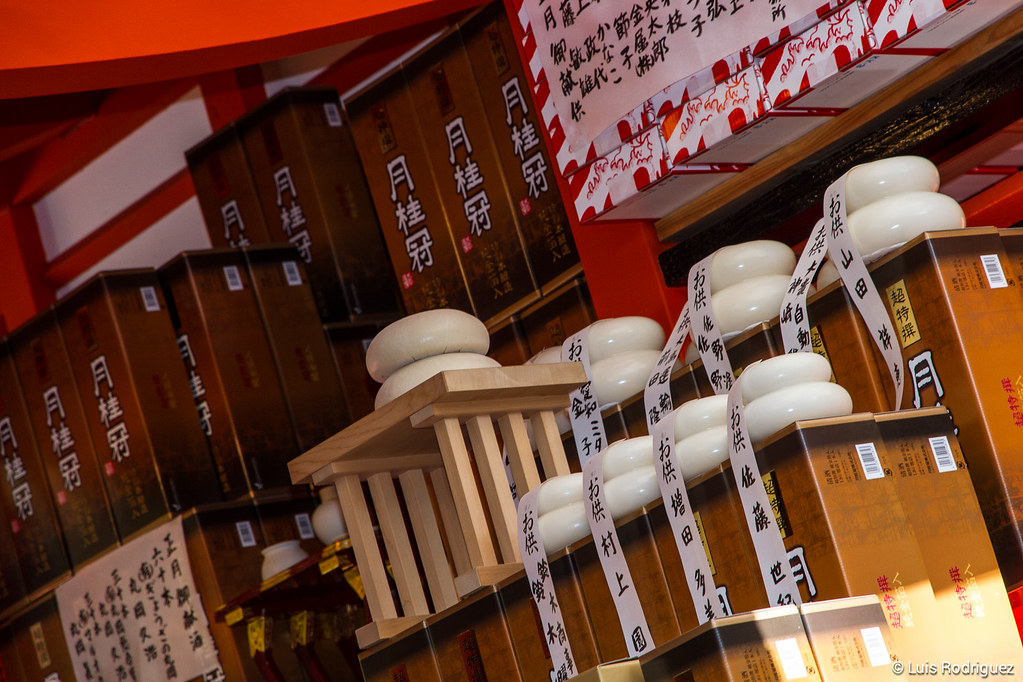
Por supuesto, como cualquier otro santuario, hay puestos en los que venden amuletos de tela omamori, tablillas de madera ema para colgar allí mismo y que, como no podía ser de otra forma, tienen forma de zorro, papelillos de la suerte omikuji, flechas de Año Nuevo hamaya (nosotros compramos una, siempre que hacemos hatsumode acabamos comprando una) y muchos otros amuletos o engimono para tener buena suerte y protección.
Pero claro, los puestos donde se venden todas estas cosas, en estas fechas, también están abarrotados.
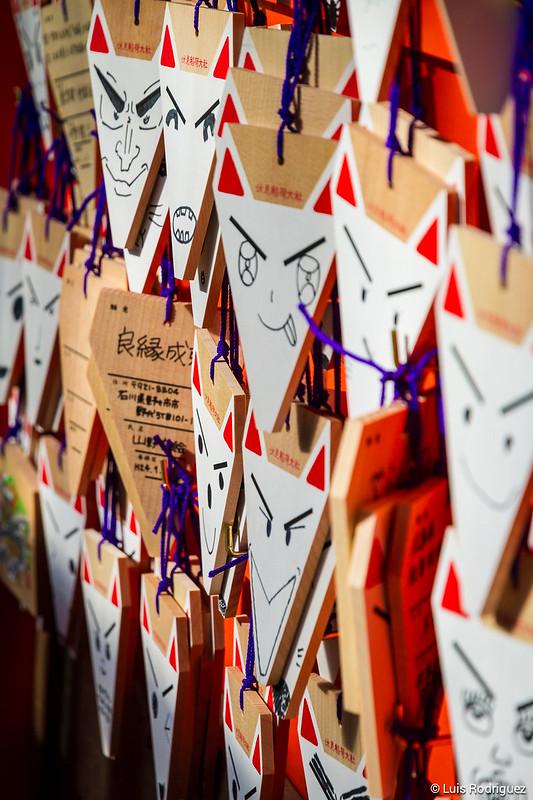
Además, al ser primeros de año, había una zona especial donde se recogían los amuletos comprados el año anterior. Porque al contrario de lo que hacemos en Occidente, que cuando compramos un amuleto o recuerdo en algún sitio se queda con nosotros para siempre, en Japón estos amuletos tradicionalmente se renuevan cada año.
Así, los japoneses acuden a los santuarios a entregar esos amuletos que ya han cumplido su papel, para que unos días más tarde sean quemados en una pira. De esta forma, se desprenden de todo lo negativo que hayan podido tener durante el año anterior, según las creencias sintoístas.
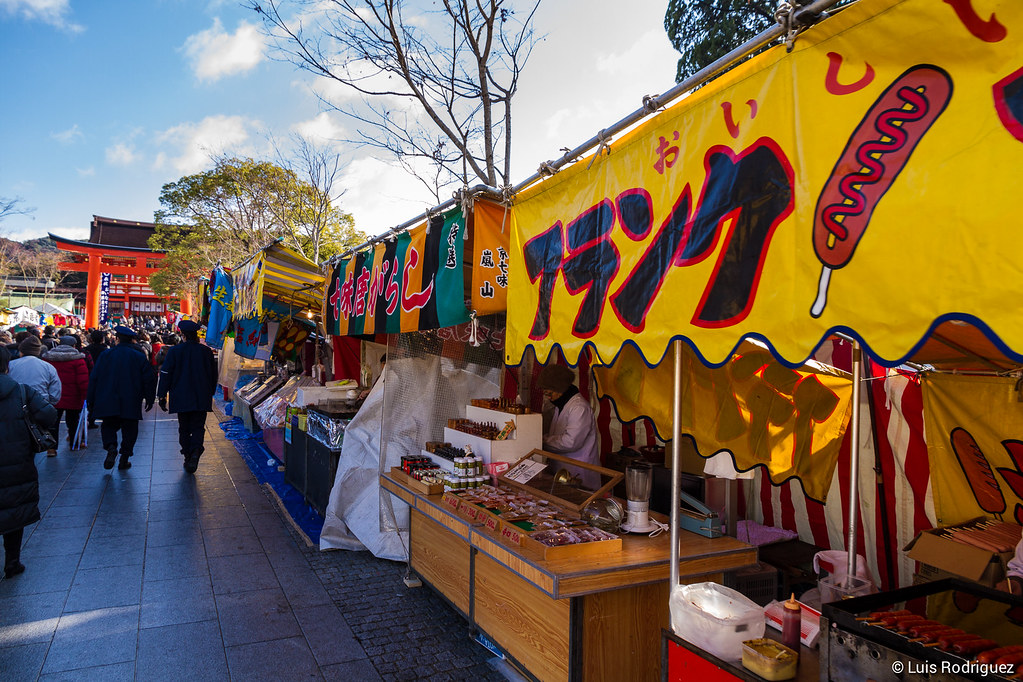
Y si visitas el santuario en época festiva, también puedes ver un montón de puestos de comida en los caminos de acceso al santuario.
En ellos puedes encontrar platos tan típicos como takoyaki (una especie de buñuelos de pulpo), yakisoba (unos fídeos fritos con repollo, bacon y lo que quieras ponerle), okonomiyaki (o «torta japonesa», a la que le podemos añadir casi cualquier ingrediente que quieras), salchichas a la parrilla, pescado a la parrilla, taiyaki, etc.
El templo, al ser uno de los más populares de Japón, siempre está muy lleno de gente. Pero si madrugas o acudes a última hora de la tarde puedes encontrarlo con menos gente.
Otros festivales y festividades
Se celebran muchos festivales durante todo el año en Fushimi Inari. Destacamos, por su importancia e interés turísticos, los siguientes:
- Oyama-sai: Uno de los festivales de inicio de año. Cada 5 de enero a partir de las 12:00 horas en la cima de la montaña, en la zona de Gozendani.
- Seinen-sai: Típico festival de Seijin no Hi o paso a la edad adulta. El segundo lunes de enero, a partir de las 13:00 horas.
- Hosha-sai: Arquería tradicional japonesa para ahuyentar los demonios. El 12 de enero, a partir de las 14:00 horas.
- Setsubun-sai: Festival típico de Setsubun. Se celebra el día de setsubun, durante la primera semana de febrero, a partir de las 09:00 horas.
- Hatsuuma Taisai: Festival del primer día del caballo (según el calendario tradicional japonés y aniversario de la creación del santuario. A partir de las 08:00 horas en el primer día del caballo (en febrero).
- Sangyo-sai: Festival de agradecimiento a la deidad Inari Okami. El domingo más cercano al octavo día del mes, a partir de las 13:00 horas.
- Minakuchi Hashu-sai: Festival del arroz, en el que se plantan semillas de arroz y se reza a la deidad Inari para una buena cosecha. El 12 de abril a partir de las 11:00 horas.
- Inari-sai/Shinko-sai: Gran festival del santuario de Fushimi Inari, con procesión de mikoshi o altares portátiles. A partir de las 11:00 horas durante el domingo más próximo al día 20 del mes.
- Oharae-shiki: Festival de purificación en el que se purifican los pecados que hemos cometido sin querer desde Año Nuevo. El 30 de junio a las 15:00 horas.
- Motomiya-sai: Gran festival de los santuarios Inari de todo Japón, cuyos fieles se reúnen aquí para expresar su gratitud a la deidad Inari. El primer domingo de julio a las 09:00 horas.
- Nukiho-sai: Festival de la cosecha del arroz plantado en abril. El 25 de octubre a las 11:00 horas.
- Hitaki-sai: Festival de otoño para agradecer a la deidad Inari la abundancia de la cosecha. Se queman decenas de miles de tablillas de madera ema y hay bailes y canciones en honor a la deidad Inari (esto a partir de las 18:00 horas). El 8 de noviembre a las 13:00 horas.
- Shinjo-sai: El arroz recolectado durante el festival Nukiho-sai se ofrece al dios Inari en una ceremonia formal. El 23 de noviembre a las 10:00 horas.
- Oharae-shiki: Ceremonia de purificación para purificarnos de todos los males cometidos durante la segunda mitad del año y comenzar el Año Nuevo puros. El 31 de diciembre a las 15:00 horas.
Cómo llegar a Fushimi Inari
El santuario de Fushimi Inari está perfectamente comunicado con Kioto, ya que está a cinco minutos andando desde la estación Fushimi Inari de la compañía privada Keihan, y a tres minutos de la estación Inari de la línea JR Nara (incluido en el JR Pass).
Si estás haciendo turismo por Japón, lo más normal será que tengas el JR Pass y llegues con la línea JR Nara. Para ello, tienes que ir hasta los andenes 8, 9 y 10 de la estación de Kioto, donde paran los trenes de esta línea.
Eso sí, no uses los servicios rápidos o de paradas limitadas, porque no hacen parada en Inari. Tienes que tomar el servicio local, y en únicamente dos paradas o menos de 10 minutos, llegarás a Inari.
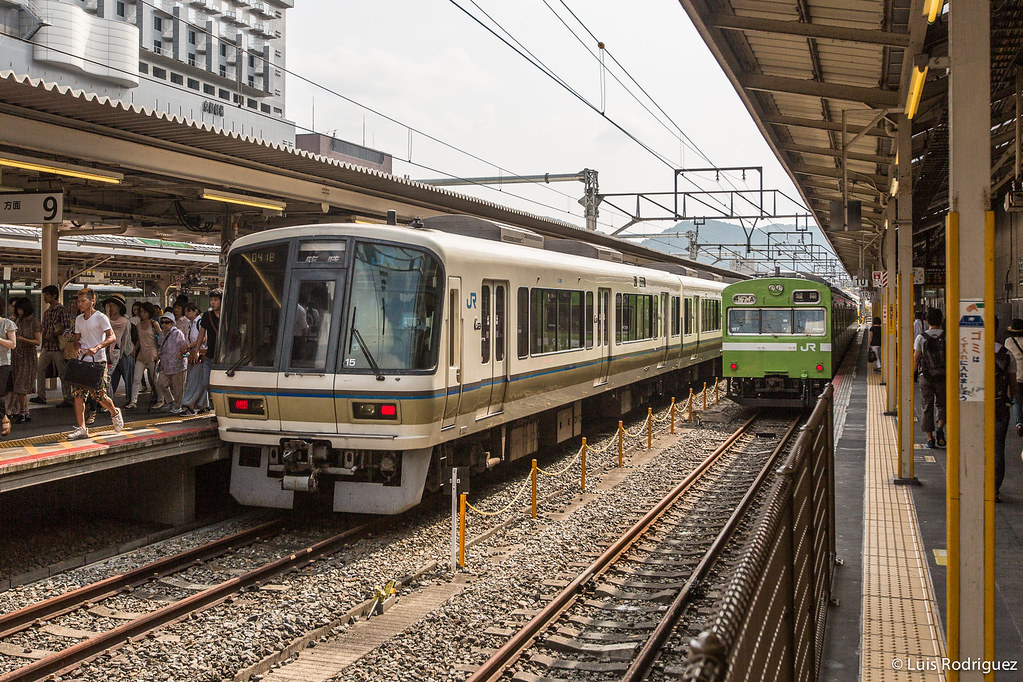
Los trenes, además, son fácilmente reconocibles porque la mayoría son de color verde y parecen totalmente destartalados y sacados de una película de los años 60 de la apariencia tan vieja que tienen. De hecho, son de la serie 103 que empezó a prestar servicio en 1964.
Sin embargo, a veces hay servicios locales que paran en Fushimi Inari que parten del anden contiguo y utilizan trenes algo más modernos. En la siguiente foto puedes ver dos trenes que paran, ambos, en Fushimi Inari. Para saber si el tren de la izquierda para allí tendrás que fijaros en si es un servicio local, como explicamos en cómo usar los trenes en Japón.
Y como tanto la línea JR como la de Keihan llegan a Nara, llegar a Fushimi Inari desde Nara es igualmente sencillo.
Alternativamente, si te gusta andar, puedes llegar dando un paseo desde la estación de Kioto por las márgenes del río Kamo (aproximadamente 3,5 kilómetros) o desde el templo Sanjusangendo (unos 5 kilómetros).
¡Disfruta de la excursión a Fushimi Inari!
 English (UK)
  Español
No responses yet