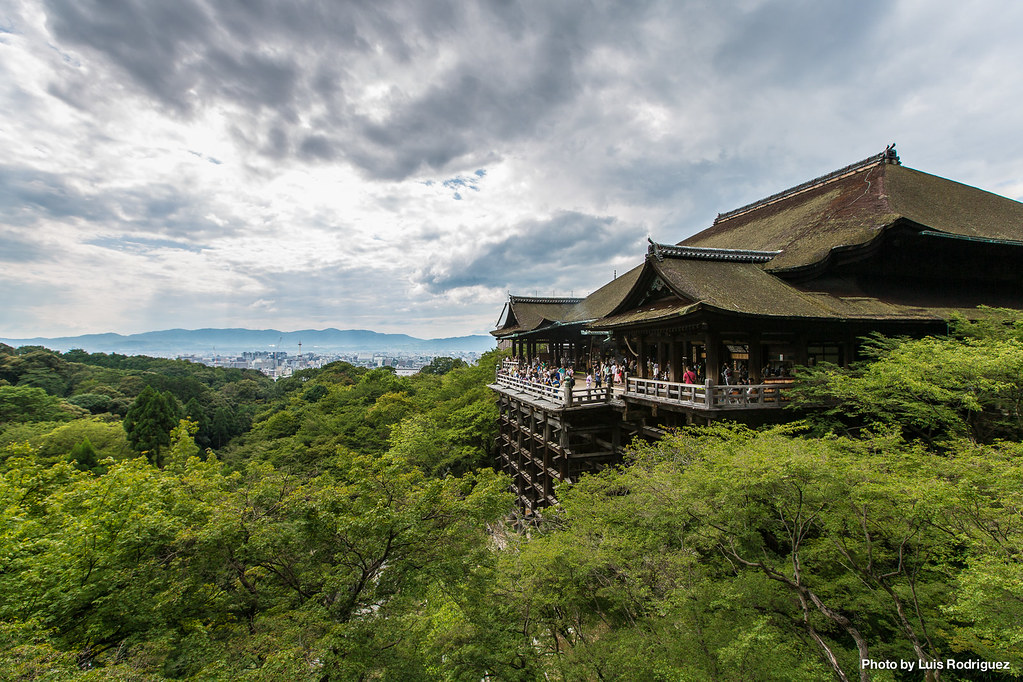
The Kiyomizudera or Kiyomizu-dera temple (清水寺 or ‘temple of pure water’) is a group of temples and religious buildings located in the Higashiyama district, east of Kyoto. It was declared a UNESCO World Heritage Site in 1994 and is, in its own right, one of the most special sights in the city.
The temple was built in the year 778 in the hills east of Kyoto, just where the Otowa waterfall was - and still is - which gave its name to the temple of pure water, clean water or crystal clear water.
However, although it was founded in the early Heian period, the present buildings date from 1631-1633, as the temple burned down several times during its long history. Kiyomizudera Temple is also one of the 33 temples of the Saigoku Kannon pilgrimage. Keep this in mind during your visit, if you are interested in getting the goshuin and to complete this pilgrimage.
In addition, we also talk about the Jishu shrine, dedicated to love and is located inside the Kiyomizudera temple. A clear example of the religious syncretism that for so long was normal in Japan.
For all these reasons, it is one of the places that we recommend you to visit in our post on what to see in Kyoto.
Guided tour of Kiyomizudera Temple
Although the main hall is the best known part of the Kiyomizudera, the truth is that the temple is actually a collection of religious buildings, some of which are better known than others. However, no one had compiled information in English about the other buildings you can see on your visit to the Kiyomizudera apart from the main hall or the waterfall. Until now.
At Japonismo we did a search for information in Japanese and live during one of our last visits. So here we go a little further and mention all the subtemples, shrines, gates, pagodas, statues and other constructions in the Kiyomizudera temple complex.
You have all these constructions marked on our general map of the Kioto's East zone. Remember that you can use the map during your trip to Japan, as explained in Maps for travelling to Japan.
Nio-mon door
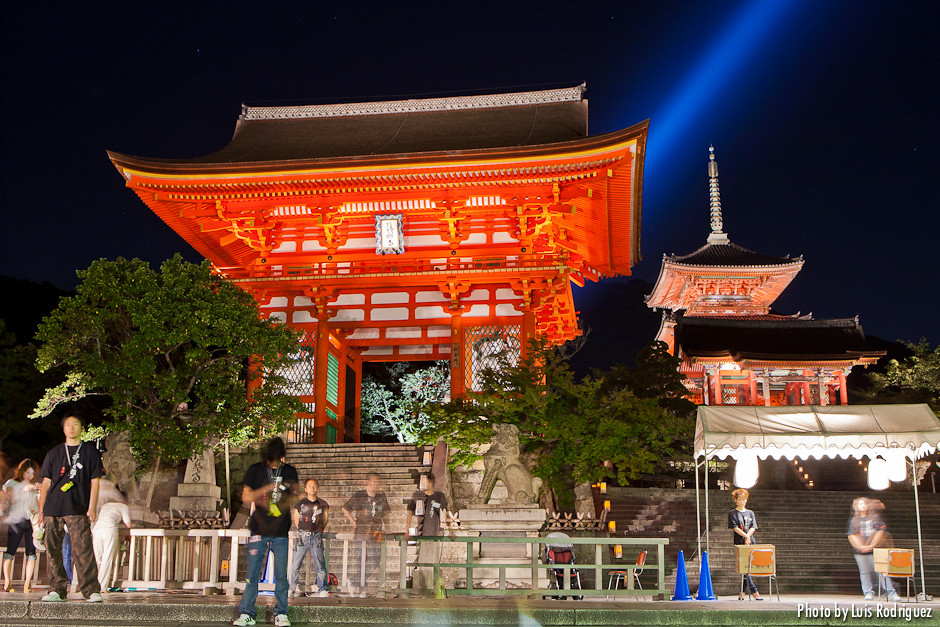
The majestic Red Door Nio-MonThe Deva Gate, known in Spanish as Puerta Deva or Puerta de los Reyes Deva, is a 10-metre wide and 5-metre deep gate made of cypress wood.
Like many other buildings in the enclosure, it burnt down in the second half of the 15th century and was rebuilt a few years later, at the end of the 15th century. Because of its striking vermilion colour, it is also known as the Aka-mon gate, “the red gate”.
The gate contains statues of two 3.65 metre high Deva kings (or Nio in Japanese, hence the name) standing guard next to two lion-dogs (the lions).koma-inu) to protect the entrance to the temple from the forces of evil.
The guardian on the right has his mouth open as if pronouncing the vowel ‘A’ in Sanskrit, while the guardian on the left has his lips closed as if pronouncing the sound ‘Om’, two basic Buddhist sounds symbolising the inclusiveness of Buddhist teaching.
Zenkoji Temple and Umatodome Stable
Located in front of the main door, the Zenkoji Temple was originally dedicated to the Jizo Bodhisattva, but was later dedicated to Amida. One of the temple's special features is to the right of the entrance: the statue of the Kubifuri Jizo, a Jizo whose head moves. Since the Edo period, anyone who wants to ask him for a favour must turn the Jizo's head in order to obtain his favour.
At the foot of the entrance door to the church, you will see the Umatodome Stable. It is the place where samurai and noblemen daimyo left their horses when they entered the temple. It is a stupendous building from the 15th century.
Sai-mon West Gate
The Great Gateway to the West or Sai-mon Gate is a reconstruction dating from 1631. Like the main gate, it is also made of cypress wood and supported by eight pillars. The decorations, in striking shades of red and gold, are very elaborate and reflect the grandeur of the Momoyama period in which it was built.
The elephant head carvings seen here are said to be a detail that came from Korea after the Japanese military incursions into that territory in the 1590s. Here we find two more Deva guardians who protect the temple from the entrance of all evil. From here we also enjoy spectacular views of the sunset.
Pagoda Sanjuno-do
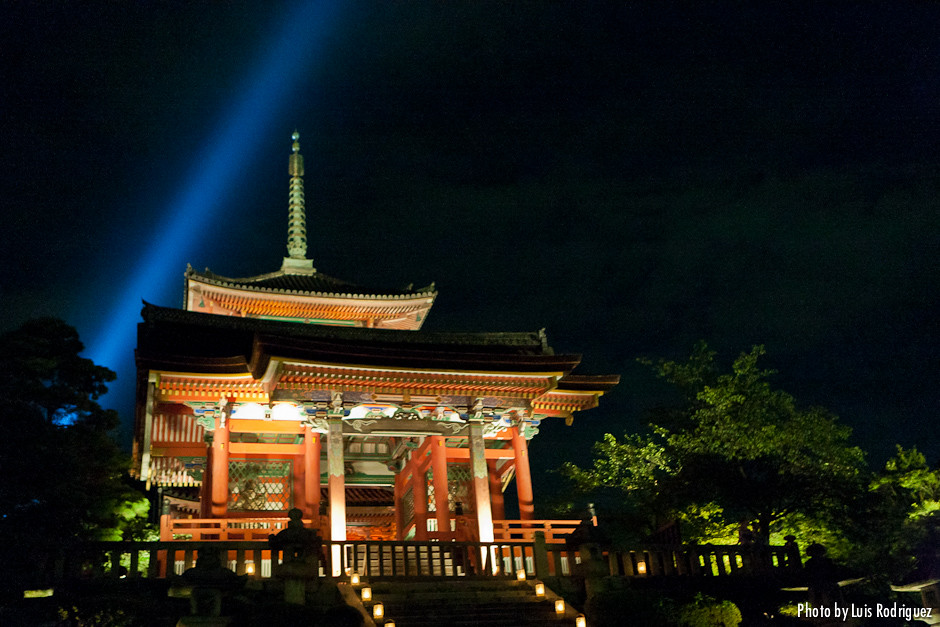
The Sanjunodo three-storey pagoda dates back to 847, although the actual construction dates back to 1633. It is the tallest three-storey pagoda in Japan, standing 31 metres high.
To reflect the grandeur of the Chinese tradition of the Momoyama period, the pagoda was repainted in a vivid vermilion-red colour in 1987. In this way, it was made to stand out from the rest of the wooden buildings on the site.
Inside is enshrined the image of the Dainichi Sun Buddha in a three-dimensional mandala.
Bell tower
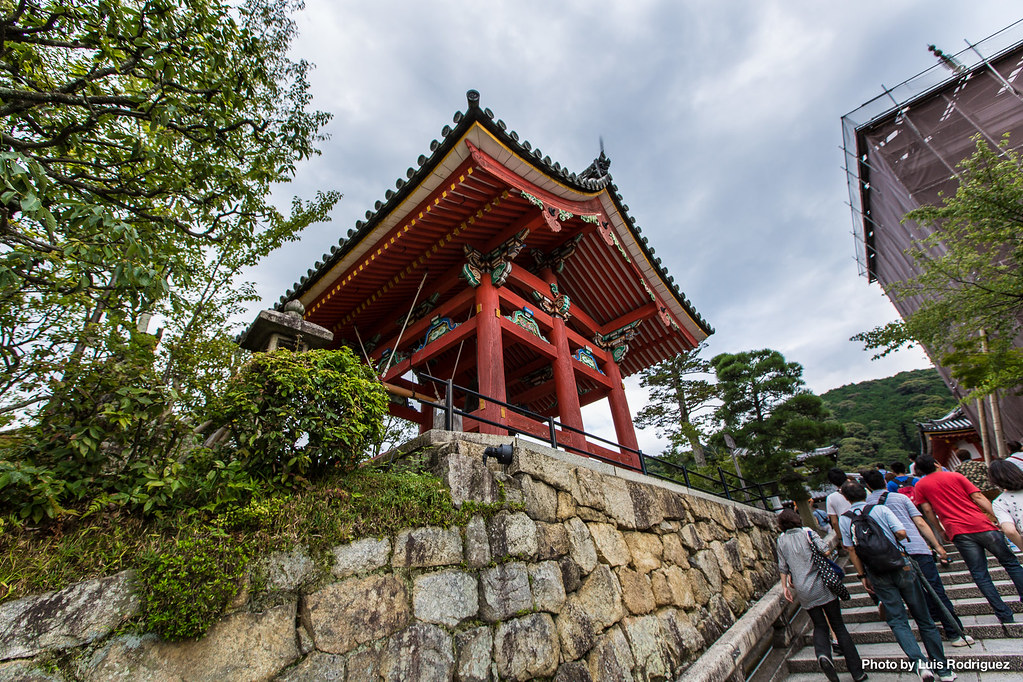
The bell tower or Shoro dates from 1596 but was rebuilt in 1607. It is a typical Buddhist bell tower, with the particularity of having two extra pillars, making a total of six. In this way, the weight of the bell can be better supported. The bell, which dates back to 1478, weighs no less than 2.03 tonnes.
The tower has beautiful carvings of chrysanthemums and peonies, typical of the Momoyama period.
Mizugo Kannon-do and Zuigu-do Halls
The Mizugo Kannon-do Salon is a small space dedicated to the goddess of mercy and specifically to unborn foetuses and aborted babies, which is why we find here a statue of the goddess Kannon holding a foetus that is quite hard to see.
The largest is the Zuigu-do halldedicated to the mother of Buddha, is a reconstruction from 1718. It is open daily from 9:00 am to 4:00 pm and you can enter (for a small entrance fee of 100 yen) to take part in the tainai meguri (胎内めぐり), the ‘pilgrimage of the womb’.
Its total darkness, with only one stone slightly illuminated with a character written in Sanskrit, symbolises a mother's womb. Entering it is a quite unique experience. You see absolutely nothing and are guided exclusively by a rope that runs through the interior. Entering the tainai meguri is to trust blindly in your faith, which is why it is said that after going through it, you are reborn and all your prayers are heard.
We did the ‘womb pilgrimage’ during the visit for the Sennichi Mairi festival and it was a very special occasion.
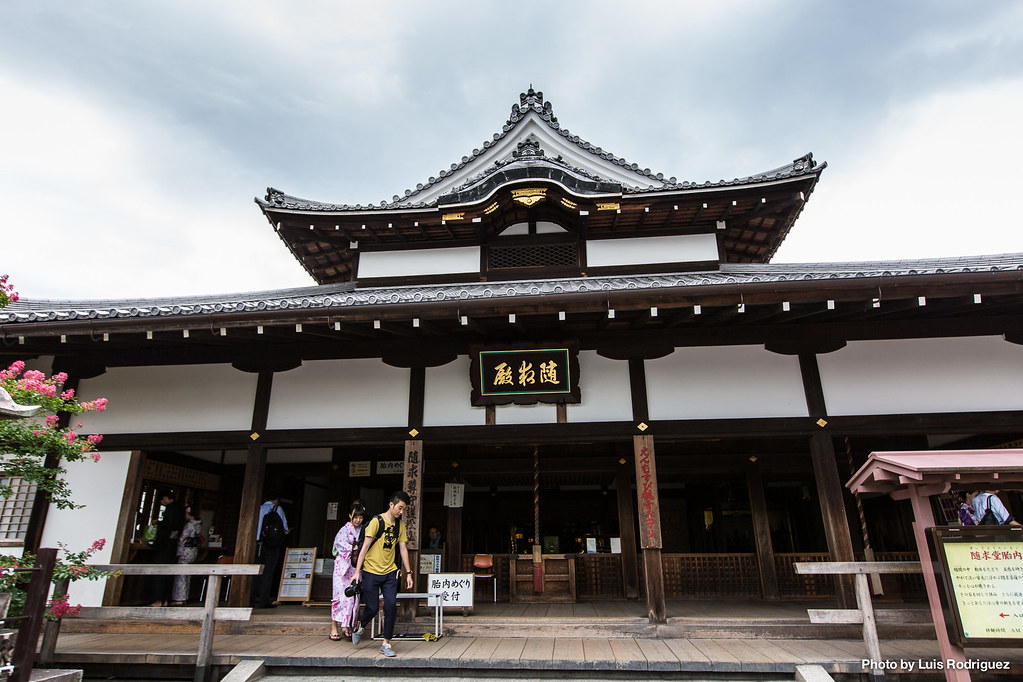
Repository of Kyo-do sutras and Kaisan-do Hall
The Kyo-do Hall dates back to 1633 and is a repository of sutras. It also serves as a reading room for the monks of the temple.
The interior ceiling is decorated with a large dragon. The main image of Shaka Buddha is accompanied by a Monju, the Buddhist deity of wisdom, and a Fugen, the Buddhist deity of virtue.
For its part, the Kaisan-do Hall or Founder's Hall is also known as Tamura-do Hall after the general who donated the main hall to the priest Enchin in the 8th century.
Inside the Kaisan-do hall are four 76-centimetre-high images on multi-coloured feet: the hermit Gyo-ei, the priest Enchin, Tamuramaro and his wife Takako.
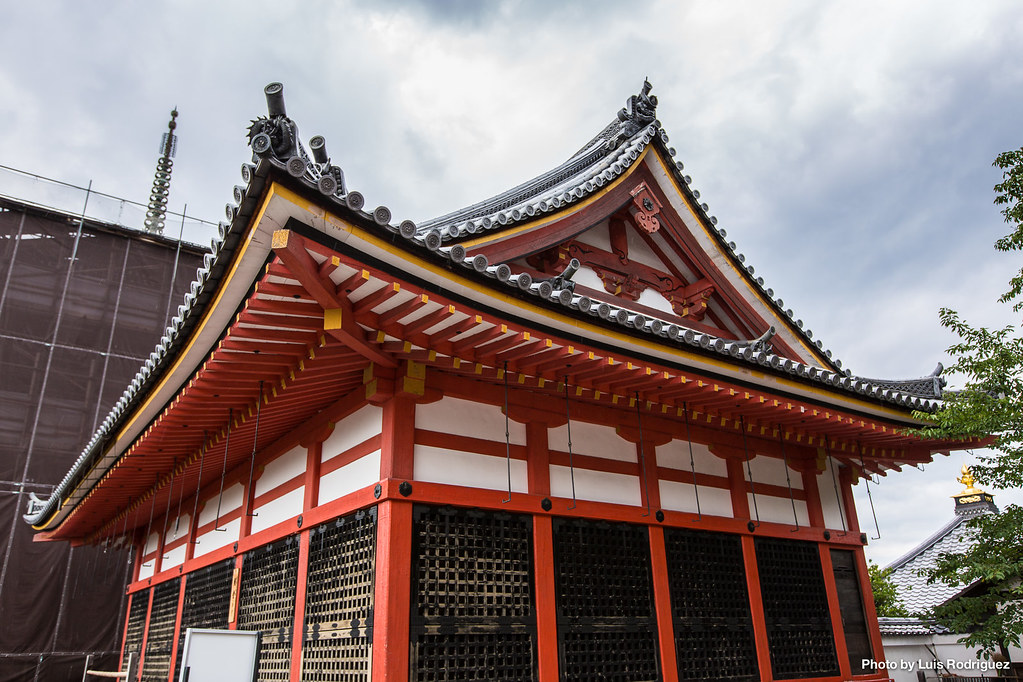
Todoroki-mon Gate
The Todoroki Gate (Todoroki-mon), sometimes also called Chu-mon central gate is a reconstruction from 1633, like many of the buildings in the complex.
Like the other gates in the enclosure, here too you will see images of two Deva kings guarding the main hall from the entrance of evil spirits. The calligraphy hanging on the top of the gate is the work of the Buddhist monk Gesshu Zenji.
By the way, just before you cross the Todoroki-mon gate you will find the ablution area temizuya, where you must purify your hands and mouth. The water that comes out of the mouth of a precious dragon is called ‘water of the owl’ (梟の水, Fukuro no Mizu) because of the patterns and shapes of owls and owls in the pile.
According to Japanese tradition, the owl is an animal that protects you from bad luck.
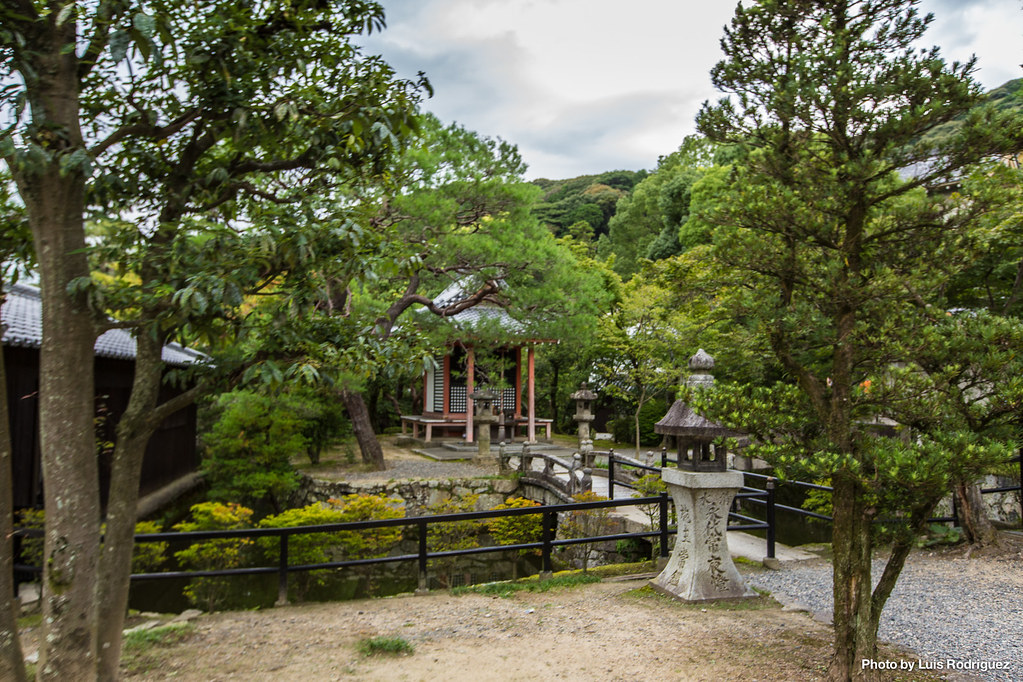
Benten Island
Behind the Kaisan-do hall there is a pond with a small islet named Benten-jima. The island contains a small Shinto shrine which houses the image of Benten, one of the seven deities of good fortune.
You may be surprised to find a small Shinto shrine in a Buddhist compound such as Kiyomizudera Temple, but this is very common in Japan. In fact, the vast majority of Buddhist temples have a small Shinto shrine on their grounds for the Shinto gods to protect the Buddhist gods.
And it's not the only case of a shrine within the temple that you'll find at Kiyomizudera, either.
Asakura-do Hall
The Asakura-do Hall, a reconstruction from 1633, it was donated by the son of the emperor Temmu, Asakura Sadakaga. Inside, we find the image of an 11-headed, thousand-armed Kannon, accompanied by Bishamonten and Jizo.
In addition, in the Asakura-do hall there is a stone with the footprint of Buddha. According to tradition, if we stare at the footprint, all sins will be forgiven.
The Kairo corridor, the main hall, with its beautiful wrought-iron chandelier, leads directly into the main Hondo room.
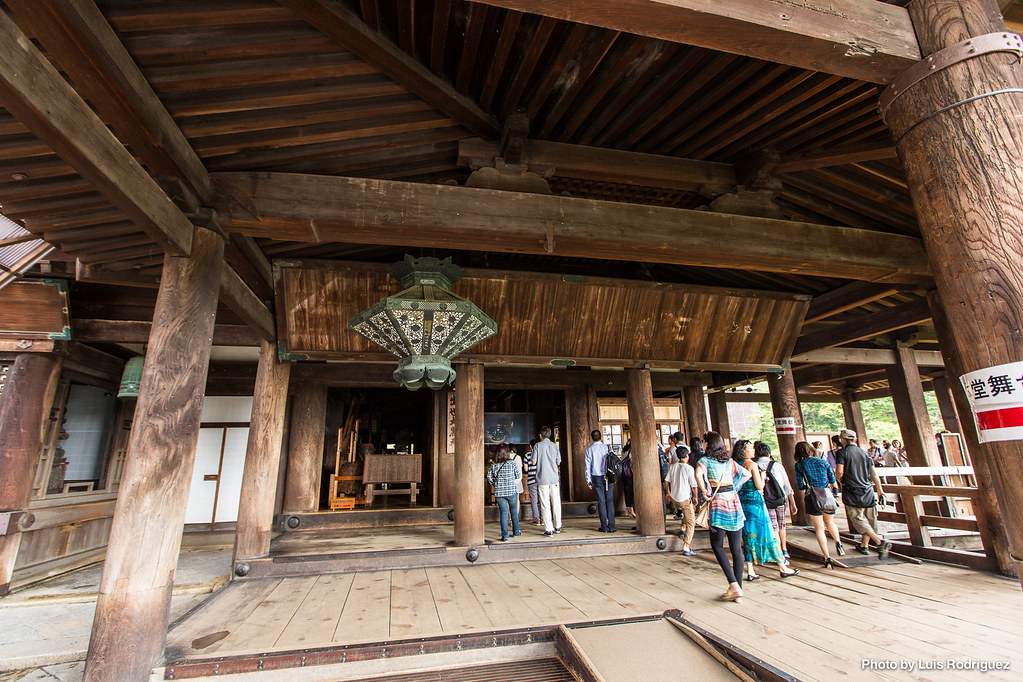
Hondo Main Hall
The Hondo Main Hall of the Kiyomizudera temple contains a small statue of the goddess of piety Kannon of seven faces and a thousand arms accompanied by 28 guardian deities.
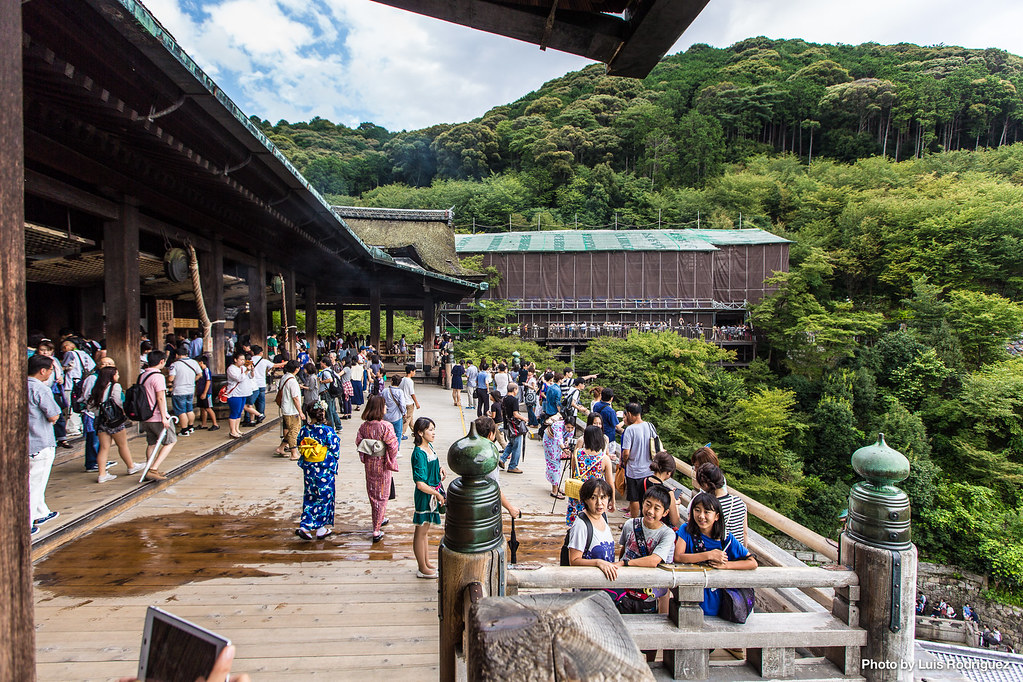
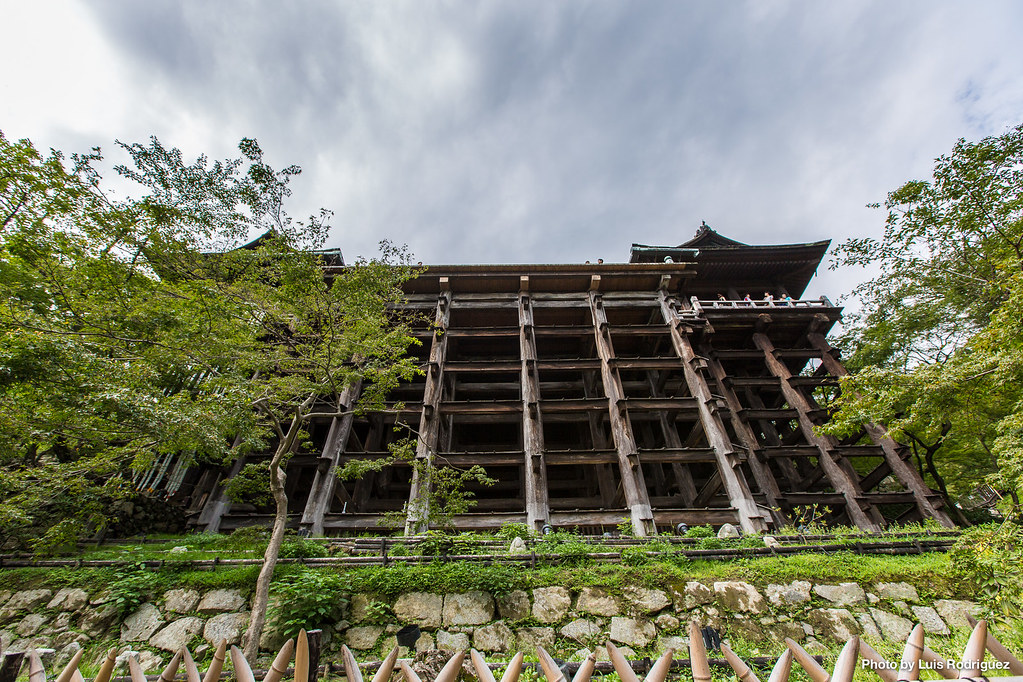
But it is also well known for the large 13-metre high balcony, which is supported by hundreds of Japanese zelkova wood pillars (keyaki) placed in the traditional manner and without any nails having been used in their construction.
So, although 13 metres is not much to think of initially, when you know how it is made, it is surprising.
The balcony, the floor of which is made of 410 cypress planks, was built in the Heian style of the previous temple. The balcony is called the butai (stage) and wings on both sides gekuya (orchestra) because many religious music and dance performances were held in this area.
During the Edo period, it was believed that if someone jumped from the balcony of Kiyomizudera Temple and survived, they would be granted a wish. There are records of 234 jumps from that period, 85.4% of which the person survived. Today, this practice is completely forbidden.
From the main balcony we enjoy beautiful views of the city of Kyoto and the nearby hills, especially during the cherry blossom in April and the changing colour of the leaves or the cherry blossoms. momiji in November, although the visit can be enjoyed all year round.
 English (UK)
  Español
No responses yet